Sunday, October 1, 2017

A Review of a Series of Essays On Comparative Rhetoric Due for This Week

Preface from the screenplay of Being There
President "Bobby": Mr. Gardner, do you agree with Ben, or do you think that we can stimulate growth through temporary incentives? [Long pause]
Chance the Gardener: As long as the roots are not severed, all is well. And all will be well in the garden.
President "Bobby": In the garden.
Chance the Gardener: Yes. In the garden, growth has its seasons. First, comes spring and summer, but then we have fall and winter. And then we get spring and summer again.
President "Bobby": Spring and summer.
Chance the Gardener: Yes.
President "Bobby": Then fall and winter.
Chance the Gardener: Yes.
Benjamin Rand: I think what our insightful young friend is saying is that we welcome the inevitable seasons of nature, but we're upset by the seasons of our economy.
Chance the Gardener: Yes! There will be growth in the spring!

The prompt for this week's assignment is as follows:

“Based on the readings for this week and the discussions on Chinglish we have had, consider some ideas/models that may help us approach translation and/or cross-cultural understanding (and knowledge sharing) more meaningfully.”

Luming Mao
Department Chair
Professor of English and Asian/Asian American Studies
EDUCATION
Ph.D., University of Minnesota
M.A., University of Minnesota
B.A., East China Normal University

"Thinking beyond Aristotle: The Turn to How in Comparative Rhetoric"

Professor Mao illustrates through "highlighting the need to study both 'facts of usage' and "linguistic and other symbolic behaviors and experiences that have been disqualified, forgotten, or deemed something other than rhetoric"--"facts of nonusage" (449). The author speaks of the Dao, and according to Wikipedia, Dao is "a Chinese word signifying 'way,' 'path,' 'route,' 'road,' 'choose,' 'key' or sometimes more loosely 'doctrine,' 'principle' or 'holistic science.' Within the context of traditional Chinese philosophy and religion, the Tao is the intuitive knowing of ‘life’ that cannot be grasped full-heartedly as just a concept but is known nonetheless through an actual living experience of one's everyday being."

I partially understand Mao’s argument but what I liked most is his comment that the "Facts of nonusage, in fact, conceal or embody conditions that led to their exile and led to the sanctioning of facts of usage. Parasitic on each other, the two become the yin and yang of rhetorical reality" And, according to note seven, facts in one culture may not be within the context of another.

I did not understand the example given nor the author's use of Zhuangzi’s quotes about "You’re not a fish--how do you know what fish enjoy?," or "Zhuangzi's reasoning about it," but I sensed it. I read Huizi's question as rhetorical "you're not a fish--so you do not know what fish enjoy." Zhuangzi's takes it as a question: "so you already knew I knew it when you asked the question." The dialogue became stuck in a recursive loop echoing rhetoric positions.

I seem to disagree with solutions ex-post facto to re-envision the future and I prefer to promote a synthesis of the present into something not conceivable--something dynamic that arises because of the trajectory of the past.

I’ll attempt to bring the Being There preface together with Mao and professor Lu below to arrive at a response to the prompt. In doing so, I risk misjudgment due to an improper framing of Professor Lu’s paper.

Professor Min-Zhan Lu, University Louisville, Kentucky  "Multiculturalism: The Politics of Style in the Contact Zone" Professing Multiculturalism (1993), or, rephrased another way as many are reading the word multiculturalism today: based on the disfunction that surrounds multicultural societies and the perception that multiculturalism is racism against white people: “Racism: The Politics of Style in the Contact Zone.” By rephrasing the title, I present one of the problems that must be addressed when considering cross-cultural understanding and that is the effect of the institutional policy.

The title words multiculturalism, contact, and zone imply an assumption that multiculturalism is something positive and associated with politics and style in a multicultural contact zone; the words assert that multiculturalism is to be taken as something worth bringing into political discussion through style. And, since this has been the case in American culture for centuries most would agree. My question, of course, is so what? And, why bring it up as something new? The article is 24 years old and around the time of modems and bulletin board internet usage. I find the content of the article within the context of limited global information sharing interesting because when I read the article, it seemed to apply as well to today. Lu quotes a lot of her words as if to pronounce them loudly; as if she is not being heard. Looking back from this time, it seems as though she sensed that a global transformation was underway and there were many back then that were not listening. I admire her paper and her intent.
Some of the words that she uses in her academic rhetoric follow. Notably missing is the word privilege:
1. Diversity
2. Contact Zone
3. import
4. articulate
5. discourse
6. ghettoization
7. aligned
8. negotiate
9. informed
10.profound 'heteroglossia'

Lu takes the route of pathos to persuade her audience through words that provoke the reader's sympathies. I believe it is enlightening to denote a few instances.

1. students at the fringe
2. anxiety
3. feel
4. worry
5. guilty
6. self-conscious
7. blundering
8. having problems
9. error
10. Mr. Roger's Neighborhood

Lu’s paper does not address a student's maturation into adulthood. It does not stress that students must develop a sense of morality by learning to deal with reality while living in a multicultural world, and it seems to presume that multiculturalism will somehow magically solve divisiveness. The obstacles to Stein and Dreiser are what made them who they were, to write what they did. I think we papers that address the importance of what it means to be human in a multicultural and diverse society rather than papers that address what it means to be a part of collectivist ideologies enacted through policy.

This where I think we can take Mao's words above and apply them to Lu’s paper. The "rhetorical reality" of political multiculturalism, political diversity, and identity politics accentuates separation and discord and breeds racism and acts of violence equal to an increase in meaningful translation and cross-cultural understanding.

In an interview on my blog by Chris Martenson of Melissa Zimdars, I give an example collective acts of violence. In particular "Suspected Berkeley [professor] Antifa Bike Lock Attacker Eric Clanton Arrested For Assault." So, what I believe Lu’s paper represents is the cultural conditioning of individuals that suffer from the listed sensitivities, beginning in 1993 and continuing to this day, into the alt-left extremist domestic terrorist group Antifa. And, I'm quite sure that Professor Lu did not foresee the potential adverse side effects of multiculturalism and diversity. I merely wish to point out that through the indoctrination of multiculturalism and diversity there are those that become twisted to the point of radical racism against people that they feel are different. That is what collectivism does. Through group identification, the other is projected from one's dark, repressed side onto a perceived enemy. The way that people become moral is that they learn to deal with their feeling side by integrating it into their total personality, and they do this by facing life without government intervention; not by institutions that protect them from individual integration.

I posted the quote from Being There because its humorous and astonishing portrayal of being in the right place at the right time. But, synchronicity functions independently of whether sequences of events lead to positive or negative outcomes. Therefore our prompt this week requires both an exigency and a productive solution rather than a policy solution (which may be worse than no answer). If a solution implemented adequately at this time, the it may lead to meaningful cross-cultural understandings simply by being there.

From my life's experience, co-operation in a multicultural workplace or academic environment is the best solution. I lived in Los Angeles for 45 years or so, and from being in a multicultural living environment, I've learned a lot. Two of my favorite literature classes were Latin American Literature which had both English and Spanish side by side on both of the books that we studied, and French in Translation with all of the French artistic authors. And, in group projects both at UCLA and CSUN my partners were from cultures other than mine. I also had a Chinese co-researcher as a partner for a two month long research project at UCLA.

Beyond the interpersonal relationships, I would immediately petition the large Internet monopolies Google and Facebook to come up with a way that let's say independent Hindi and Chinese media productions be made available to Western world users in their feeds. In other words, open up the Internet in such a way as to show what is essential in one part of the world as being important in another part of the world. News feeds should automatically be translated and trending no matter which physical part of the world people live. The commodified ghettoization of global cultures should be freed from servitude to the monopoly powers.

I believe academic solutions should focus less on historical culture. Instead, more productive solutions of multiculturalism are ones that rely on what is synergistic within the current global information system of the Internet, uncensored and non-commodified. The way people naturally interact may lead to a less multi-polar world so that multiculturalism arises not out of policy, but from the readily learned morality of the individual to unite with what I imagine Zhuangzi naming "being there." Or, said another way, knowing through the experience of not knowing; by being there immersed in the information, perceptions of whatever it may be, at the level of the simulacrum, uncontaminated and open for discussion.


Tuesday, September 19, 2017

"Interpretations of 'Chinglish': Native Speakers, Language Learners and the Enregisterment of a Stigmatized Code" by Eric Steven Henry, and Chinglish by Henry David Hwang


[David Henry Hwang is a Tony Award-winning American playwright, librettist, screenwriter, and theater professor. Wikipedia
Born: August 11, 1957 (age 60), Los Angeles, CA
Spouse: Kathryn Layng (m. 1993), Ophelia Chong (m. 1985–1989)
Awards: Tony Award for Best Play
Parents: Dorothy Hwang, Henry Yuan Hwang
Books: FOB and Other Plays, Chinglish (TCG Edition), 
How does Act I of Hwang's Chinglish represent various attitudes toward Chinglish and China English that Eric Steven Henry's article "Interpretation of 'Chinglish'" discusses?
Eric Steven Henry, in his article "Interpretations of 'Chinglish': Native Speakers, Language Learners and the Enregisterment of a Stigmatized Code," argues “that Chinglish is not distinguished by the presence or absence of any particular linguistic feature, but a label produced in the intersubjective engagements between language learners and native speakers. Chinglish is structured by and reinforces the relations of expertise within the Chinese English language speech community, thus representing larger anxieties about nationalism and modernization in a global context” (669). “Act I” of Henry David Hwang’s play Chinglish “represents various attitudes toward Chinglish and China English that Henry’s essay discusses in several ways. To show how Chinglish represents these attitudes it is necessary to understand what Henry means by the word enregisterment. Barbara Johnstone in her article “Dialect Enregisterment in Performance” (2011) defines enregisterment and contextualizes its meaning:
[t]he process by which sets of linguistic forms become ideologically linked with social identities has been called ‘enregisterment’ (Agha 2003, 2006). Enregisterment occurs through ‘metapragmatic’ activities that permeate discourse (Silverstein 1993). These are activities in which people show one another how forms and meanings are to be linked. In recent work, my colleagues and I have been exploring how one set of linguistic forms has become enregistered as the dialect known as ‘Pittsburghese’ through a variety of discursive practices, including face-to-face conversational interaction, online discussion board talk, personal experience narrative, and the production and consumption of t-shirts (Johnstone 2007a, 2007b, 2009, 2011; Johnstone, Andrus and Danielson 2006; Johnstone and Baumgardt 2004). (1-2)
Thus, the title of Henry’s article addresses the labels “the faces,” the personas, that people and societies put on, but through the communicative enregisterment process, the result of which is Chinglish, discover labels, the faces/masks, are but a pretext, a gloss over the baseness of identifying with things such as nationalism, a title of judge in a lawless society, the use of guanxi for personal gain, that very baseness of identifying with signifiers that signs in Chinglish readily expose. In other words, falsely identifying oneself with a label causes anxiety. And, communications through Chinglish reveals the falseness of such labels by its use as an intermediary language of culturally diverse interpersonal relationships.
   Henry states “The explicit interpretation of Chinglish as a barrier to understanding (a communicative issue), overshadows the implicit negative valuation of its speakers (a symbolic issue), and the extension of this evaluation to the social group, and nation, as a whole.” Throughout Chinglish, relationships bear these facts out. As Henry goes on to explain, “The discourse of Chinglish . . . is a discourse on modern Chinese identity” (670). In “Chinglish” the business is that of communicative signs. Guanxi, the business of relationship is successfully accomplished during Daniel’s first encounter with Minister Cai except when Vice Minister Xi Yan, a female, implies that Daniel’s sign company may not be required:  “the problems with the Pudong Grand Theatre [mis-translations on signage] . . . have been corrected” (Hwang 29). As Qian attempts to explain “The Vice Minister is . . . drawing a comparison between attempts to make translation both in Western and in China, also pointing out the absurdity of both cultures” (Hwang 31). Thus, proving Henry’s point above that “a communicative issue [] casts a shadow on “a symbolic issue.” It brings to light the reality that a person’s identity is something other than a face or mask of cultural substance.
   Despite both Daniel and Xi being speakers of each other’s languages (Xi doesn’t know that Daniel speaks Chinese yet) on a more interpersonal enactment they resort to using Chinglish. Each unmasks their feelings by speaking about their spouses in the following Chinglish dialogue:
Daniel: . . . My wife--if I started to tell you! . . . My wife and I” Really. Not perfect.
Xi: My husband, only thinking himself, so therefore, no understanding.
Daniel: And he doesn’t know you are here?
Xi: He not ask.
Daniel: The two of you don’t--talk so much? No talking?
Xi: Is better, agree? Husband and wife, not so much, talk?
Daniel: Wow. Back home, that isn’t really a // philosophy--
Xi: Making the long marriage. You, your wife--talk?
Daniel: Do we--? Well, since I’ve been here in China. With the time difference. Day is night, night is day.
Xi: Yes. Husband, wife. Day, night. We agree.
Daniel: I guess. And you’re OK with that? You want that?
Xi (Laughs, then): Nobody ever asks. (Hwang 58)
Unpacking the dialogue above to point out the use of Chinglish by both Xi and Daniel in their interpersonal relationship reveals a counter-argument to Henry’s idea of “Chinglish as a barrier to understanding” and a “negative valuation  (symbolic) of its speakers”. Despite Xi’s ability to speak almost perfect English, as in her repudiation, during their business meeting, of Daniel’s reason for wanting to be the professional in charge of supplying perfectly translated signs. Here, Xi drops the auxiliary verb doesn’t in her line “He not ask, ” and she drops the subject “It,” the auxilliary verb “do” and the subject “you” from her question “Is better, agree?” Further, Daniel uses Chinglish by dropping the subject “We” and the verb “are” from his reply in the first line above “Not perfect” when he means to say "My wife and I are not in a perfect relationship either." Both Xi and Daniel utilize the process of enregisterment to express meaning through their use of Chinglish. Far from a “barrier to understanding” Chinglish helps Xi and Daniel communicate in a deeper interpersonal relationship by allowing each to express their feelings (should I say show their real face) to one another in the social context of each other’s cultural marital traditions. Xi’s use of the Chinglish analogy “Husband, wife. Day, night” reveals their understanding that the reality of the institution of marriage is that it may lead to a loss of communication in both cultures; their mutual understanding is sealed by Xi’s statement “We agree.” Linguistically, Xi's Chinglish "Husband wife, Day Night" may be said to enregister the phrase through its indexical link to communications necessary, but not existent in either Xi's or Daniel's case, for a healthy husband and wife relationship regardless of culture. In a way Chinglish may play a role as a register that is similar to the acceptable use of baby talk during romantic dialogues; unconsciously proceeding, without much thought about risks, to be heard and understood outside of the constraints of the formalities of language, to communicate one's vulnerable but genuine feeling side to another person. And, although my counter-argument to Henry may apply in one sense, Henry continues within his article to mention that Chinglish may have “an underlying hint of charm,” as in Xi's and Daniel's dialogue above. And, Xi’s analogy indeed “comes to metonymically represent the social value of the speakers” as it relates to the value of communications within the institution of marriage (672).
---------------------------------------------------------------------
Part B from the following weeks prompt: What is David Henry Hwang trying to communicate through Chinglish, the play? Use textual evidence (and analysis) to support your answer.
David Henry Hwang mentions that he feels that romantic love has become, to him, a kind of humanistic religion that has replaced the old religion of the Middle Ages, and that popular art is "to glorify romantic love" (A Conversation 4). Much of the play's emphasis is on the state of romance in both Chinese and American cultures, but as an artist, I think Hwang is interested in going beyond popular culture to express through humor what could not be said more easily. His interest is not mainly to show that people of both Western and Chinese cultures are contemporarily nearly the same in manners of an individual's need for personas, marital relationships, and romantic love. I believe as an artist Hwang is most interested in answering the question suggested to his audience of pop culture minds: "If something cannot make money, is it valuable? So what do we put up in the cultural center?" (A Conversation 5).

Hwang's question is introduced to the audience when Minister Cai mentions the Party Secretary calling and "asking how [he] plan[s] to attract more tourists!" (Chinglish 54). Cai afterward asks out loud "Does that mean everything now has to make money?" Which brings up a satirical point about the cultural revolution that used brutal force to bring about cultural change. But, Hwang turns it into humor by having Cai say "sometimes I miss my old army days" (Chinglish 55). So, that is the point of the question. If you can't use taxation, or force by some means that allows for the undying performances of the Chinese Acrobats how does a cultural center survive? Or, even for that matter, remain cultural? It is in answer to this question where I believe the esthetic value of Chinglish resides. Hwang creates a kind of double entendre to first ask the question through the use of satire and then provides the play as the answer. It is sort of risky boldness to employ commercialism as esthetic value, but not something that I think goes beyond the artist's conception of bringing the meaning of art through the new religion of romance to his audiences. I mean to say, how does one reveal to the masses the importance of art without the use of a humorous adventure? But, the beauty of the play is in the way that it brings to light so many issues, such as language, culture clash, political corruption, the falseness of character, relationships, and so on, all in two Acts.

Tuesday, September 12, 2017

Timbur In Light Of Ricento

Note: If you see this sentence then I'm working on a Google slideshow presentation of what is below.

The acronym ELF provides an abbreviated means of discourse for the overused and lengthier--contained/labeled--concept of English as a lingua franca.

The letters ELF say nothing as to the nature of what English as a lingua franca means yet presupposes a level of understanding.

To those unacquainted with the acronym, it appears presumptuous thereby making the reader more acceptable to believe once the definitions of the Italian words are known that the concept is understood.

As Thomas Rincento illustrates throughout Language Policy and Political Economy, the acronym is as obscure as a worn out label on a bottle of an unidentified and unidentifiable substance. Although, if and sometimes when clarification of what the chemical composition of the contents is the labeling ELF has value.

Despite the uncertainty of categorization and tendency to extrapolate special case studies to imply that what takes place in the microcosm will take place in the macrocosm, educators, sociologists, and policymakers use and misuse the concept of English as a lingua franca.

My presentation attempts to illustrate some of the issues to be wary of through a contrast and comparison of John Trimbor's essay "Linguistic Memory and the Politics of U.S. English" and Ricento's book.

Admittedly, Ricento and the many authors of the information contained in Language Policy provide me with an unfair advantage for the contestation of Trimbur's conclusion which states the author's desire to have a "national language policy [that he believes], goes beyond a discourse of linguistic rights to imagine the abolition of English monolingualism altogether and the creation in its place a linguistic culture where being multilingual is both normal and desirable, as it is throughout much of the world" (587).

Tuesday, September 5, 2017

Authors Thomas Ricento and Gloria Anzaldua

Language Policy and Political Economy by Thomas Rincento

Thomas Ricento
Thomas Ricento is Professor and Research Chair at the University of Calgary, Canada. He has published widely in the field of language policy and on the politics of language in North America. He was a Fulbright Professor in Colombia (1989) and Costa Rica (2000), and a visiting professor at universities in Chile, Germany, Spain, and Switzerland. He was Director of English Language Programs at the Japan Center for Michigan Universities, Hikone, Japan from 1989-1991.


 I enjoy reading Ricento's book. With it, I've been able to place many ideas that I've had into more rounded associations with what I have seen taking place but have not thought about until now. Notably, within academia and the political sphere, his writings have made me aware of what communitarianism is and why it seems to be being implemented within U.S. colleges as policy. Unfortunately, for most of what is within chapters one through four I have yet to encounter the statement "Since corporate control of Western governments represents a modern day form of fascism, governmental policy is always to be classed as a form of colonialism, and any and all laws created are imposed for the profit of corporations. Therefore, any so-called social justice regulations shall be used to further suppress the populace into serving corporate interests." Although the text never goes so far as stating the obvious, it may be easily surmised by the honest and factual information put forth. Taking my point as a premise, it leaves moot any arguments from such authors as Kymlicka about group rights or individual rights because anything provided by the government is a guarantee to gradually take away all rights of those subject to the law in favor of corporate "rights." Corporations do not and cannot have morality because they are not an individual! Let me be brief here because more of what I have to say may be made clearer after first looking into the cross-textual connections between this week's readings.

Gloria Anzaldua (September 26, 1942 – May 15, 2004) was an American scholar of Chicana cultural theory, feminist theory, and queer theory.  

Anzaldua presents the theme of corporate colonialism when she mentions "U.S. colonizing companies" (32). Now that corporations are global all nation-states are but enforcement arms of borderless parasitic colonizing entities. This is the real world and not some academic fantasy land that we live in. It is past the time that all of the people should come together to address the threat. The end of corporate colonization may occur in either of two ways. The one end is the entire consumption of all peoples and resources into one corporate entity that eventually consumes itself. The other is some change brings about an end to the horrors now being inflicted on people by the global corporate elitists' systematic colonization. Anzaldua writes the article as a communitarian piece with identity politics as a theme when she speaks of the white conquest of the Americas and how her ancestors were mistreated by the whites. She fails to talk about how in the past whites were enslaved and abused by other whites, vaporized masses of fellow whites in ovens, and built the most complex society in history. The act of mistreatment is subordinate to greed and should it work to the benefit of greed then people everywhere would be lining up to subject themselves to slavery as they very much do.

Further verification that Borderlands may be classified within the identity politics genre is in the second chapter where the author speaks of boys being told to beat their wives, the use of the terms "other," "half and half" and homophobia: all things that most people don't really care about; things that have little or nothing to do with the ongoing corporate colonization taking place today; much as it took place when the author speaks of the exploitation of the indigenous populace in the first chapter. Something seems to be missing to me and that is the circumvention by the elite to use the educational system to deflect the injustices of global corporate colonialism by way of communitarianism/identity politics such that the actual cultural tyranny they inflict is transferred from them to racial or identity groups within their subservient populaces: through the establishment of racism, the myth of homophobia, and sexism; all of which are fabricated to rise within an existing homogenized and highly contemporary society. To me the implementation of communitarian ideology by academia already proved it on the path of other communist ideologies such as Stalinism and Maoism through its social justice efforts to shut down free speech via political correctness and censorship, violent political aligned protests, and the tearing down of statues, the re-writing of history and all such things that lead to the stamping out the only source of morality, the individual. Inevitably this leads to a cultural revolution and the mass murder of tens of millions of people, none of whom are likely to be members of the elite ruling class.

Outside of the sentimentalities of individual concerns imbued into the prose of Anzaldua, Ricento states the global corporate fact that "[o]nly the countries that invest massively in education and research can appropriate the foreign technologies necessary to catch up with the rich countries" (39). NAFTA minimized the effectiveness of the border wall between the U.S. and Mexico allowing U.S. (and now globally owned corporations that had once been U.S. based) corporations to do what was necessary for the establishment of autonomous Mexican corporate operations. With the achievements of NAFTA complete and with the multinationals influence over the nation-state government of Mexico, the wall can go back up like a quartering off of a prison cell block for easier multinational divide and conquer control. This time the wall seems to be more to prevent capital flight as recently implemented through various means in China rather than to have anything to do with immigration: it is being built to keep U.S. citizens or Mexican citizens from fleeing with their wealth during any future economic uncertainty. Multinational corporations and the elite class that owns them are global and not restricted by inconveniences of nation-state borders. They are the new masters of a global slave-based economy established by way of modern colonization methods: control the nation-state governments; turn the populace against one another. And, if that doesn't work, then create terrorists, Islamify the EU and as a last resort turn their countries into rubble: as in the Mid East.

So it is that I'm mystified by the value academics place on English or language as it relates to social justice or if whether or not English should be the preferred lingua franca because of this or that. The value of these concerns when compared to the "bull within the china closet," the one that such issues are subservient to, is very small. It is as if they are completely unaware, although here I presume that being able to write what I have, that Rincento is equally if not more aware than I and cannot write such things in an academic book. He comes out and says that "[t]he agendas and policies of the International Monetary Fund, the World Bank, and the World Trade Organization, for example, are determined largely by self-interested governments of the original G-7 countries, which are greatly influenced by the largest banks and corporations, all of which seek to maximize their self-interest when it comes to investment and trade policies" (38). What he does not say is that those banks print money and give that money to other banks and lend it to corporations at zero percent interest rates. Or that they can buy corporate bonds like the ECB, or government bonds and stock ETFs or like the Swiss National Bank become the largest stockholder of Facebook, or as in the United States purchase so many mortgage-backed-securities that they become the largest mortgage holders in America. Corporations are now in the process of taking title to all assets in the Western world by printing up money out of thin air for their owners. So, this is my mystification. Academics are supported by student debt, loans that come from a government under the control of corporations. They fail to see that this debt removes an entire generation from the purchase the real property that the corporations are currently taking title to. How can it be that academics write about justice, language rights, democracy, and participation in communitarian ideology, or concern themselves with whether or not English is going to provide some upward mobility when they are participating in, benefiting from and therefore complicit in the greatest inhumane colonialization by an elite class?

I can't say enough about how much I appreciate having to read Rincento's book for an assignment. I've recommended it to my brother, an English professor at LAVC, and to all of my Facebook friends. I especially liked learning about the key words and terms such as liberalism, neoliberalism, social justice, identity politics, language rights, the conceptions, and misconceptions that the author's hold about democracy, capitalism, mixed-economies, nation-states, communitarianism, code-mixing and so on. I fell in love with the book when Rincento stated that the elements of Van Parijs's argument cannot find "common ground and common purpose in a world in which everything has been, or will soon be, commodified, owned, and priced, with the owners increasingly controlling decisions about economic inputs and outputs on a global scale in the service of their own economic interests" (33).


Thursday, August 3, 2017

An Essay About Calypso's Island

Raymond Steding
Instructor: Professor Doten
English 50
December 16, 2013
An Essay About Calypso's Island

Related image
Archibald MacLeish
Calypso's Island, written by Archibald MacLeish, a modernist poet, answers the “Make It New” slogan of Ezra Pound's modernist calling with the art of a Statesman and sophistication of a Librarian of Congress. Calypso's Island a love poem by an acclaimed public figure comes from the mind of one of the world's most eloquent orators.
The content of the poem may be surmised in the three sentences that make up its 33 lines.
In the first sentence, stanzas 1-5, Odysseus tells Calypso that the woman he is speaking of, (Penelope; implied by myth), can't match her god-like qualities. Odysseus then asks the goddess to make him whole and keep him in protection on her island. In the second sentence, stanzas 6-8, Odysseus tells Calypso of the beauty of her island; that it is especially so without the pain of the heart. In the third sentence, stanzas 9-11, Odysseus tells Calypso how her island converts the storms of the corporeal world into forever new, cool, moistness. He becomes startled when he realizes that the woman, that he compares Calypso to, will die from change.
Readers may gain a truer interpretation of Calypso's Island when an association of Odysseus is made with the context of Macleish's life, and then, with the context of the reader's own life. In World War I, MacLeish served as an ambulance driver, not unlike, the psycho-pompous conveyor of souls, Hermes. MacLeish has characteristics that match both Hemes as trickster and Odysseus as the intelligently cunning one. MacLeish served the Office of War Information and became heavily involved with creating propaganda during WWII. MacLeish also maintained friendships with contemporary modernists and was the person ultimately responsible for the release, from prison, of Ezra Pound. His
Steding 2
soul like Odysseus's and Hermes's wore many hats.
After the war, MacLeish became instrumental in the creation of the United Nations Educational, Scientific and Cultural Organization. His devotion to UNESCO may be likened to being stranded on Ogygia. Some have identified Ogygia with the lost city of Plato's Atlantis—an ideal state.
In the Odyssey, the island of Ogygia is where the nymph Calypso, daughter of Atlas (Atlantis), held Odysseus as her love and kept him from returning to his home in Ithaca. Calypso's Island is a place of the gods, not humans. The island is a refuge where the chaotic forces of the world are brought into harmony with existence. In the poem, we read, “keep me from those dogging dangers-- \ Ships and the wars–in this green, far-off island” (12). And, “Your poplars where the storms are turned to dances” (27). Ogygia is an ideal state and Macleish, as Odysseus, laments subversively throughout the poem. He compares his mortal inferior “other half” to Calypso; an apparent wrongful justification of his devotion to Calypso (his godly ideal) instead of to his earthly family, his poetry, and, his individual life.
On the surface, the poem appears to be of Odysseus, as a trickster, flattering Calypso so she will allow him to leave Ogygia. But, he does not hate Calypso. Odysseus seems to honestly be in praise of her, while at the same time he wishes to return home—to his individual life. The poem is an extended metaphor for the irreconcilable conditions, in Macleish's life--between his collective duty and his individual development.
Psychologically the poem refers to two aspects of the feminine side of Macleish's personality; the side that links him to the greater collective unconscious—the underworld's birthplace of socially transforming ideas and the side that provides personal psychological development. Calypso holds him captive; communicates with him in caves; romantically she seduces him and prevents him from his personal life. The island is his goddess’s; not Odysseus's. Odysseus praises Calypso and asks her to make him immortal and strange. The world of the gods, the archetypes, is strange; not the place of mortals. After years, of devoting life to Calypso, Odysseus recognizes what he has sacrificed. He
Steding 3
expresses in the last lines of the poem his realization that his feminine side, his connection to personal development, as represented in the poem by his comparison to his mortal wife, will die: “she is a woman with that fault \ of change that will be death in her at last!” (33).
Odysseus professed and acknowledged his respect and devotion to Calypso. At the same time, he recognized his opposing feelings for the love of his other half. A dynamism arose, from his realization, enough to activate the gods on high, Athena and Zeus, to change the world about him. The world changes when Odysseus's situation in life is brought to consciousness. A raft for the newly prepared mind to cross the ocean of uncertainties becomes available for Odysseus. He will travel across the dangerous sea, in spite of his adversary Poseidon, and return home.
Calypso's Island, like the myth, relates to some common, archetypal, psychological condition. Each person has at one time become stuck, stranded in life, without the ability to determine the way out. By recognizing the situation and then coming to terms through acceptance of, perhaps even through honoring, it--by bringing it to consciousness—and then making oneself ready to move on, the gods, that have often been prayed to during this personal struggle, respond in a ways not unlike the “deus ex machina” within Greek drama. Doors open where there were none and external challenges to match the maturity and capacity of the individual arise. In this way, life mysteriously leads us all through an Odyssey toward a higher self.
Modernist works of art typically invoked the participation of the viewer/reader; to become one with their jazz that they should know it. Pablo Picasso, Matisse, T.S. Eliot, Ezra Pound, James, Joyce, Djurna Barnes all produced works through which the interpreter of their works was led to a greater understanding of themselves. Through individual interaction, the beauty hidden in their medium became known.
The subjective interpretation of Calypso's Island I have offered may be valid, or not, but Macleish's art, within the poem, attains its classification of being “modernist.” The subtle rhyming
Steding 4
pattern of the second line of the stanza, with the first line of the following stanza, the alliteration, repetition from the end of one line to the beginning of the next, similes, metaphors and the allusions within Calypso's Island, as well as, the myth of the archetypal psychological process that the poem is based on, all draw the reader to become one with the poem. Calypso's Island is a song sung by a nymph.
In 1937, in Germany, modernist art was forced underground and classified as “degenerate art.” Djurna Barnes's novel, Nightwood, was published in America that same year. MacLeish as a modernist poet, with political and cultural influence, would certainly have been motivated to confront the fascist subjugation of individuals and the repression of individuality inspired by the modernist's works.

Calypso's Island concerns a problem central to the maturation of the individual. Psychological development is thwarted when the individual gets lured into the collective. The power of identification with the ideals of the gods crushes the only salvation for society--the morality and creativity of the individual. Whether or not MacLeish's personal involvement with the military or UNESCO had an influence on this poem, I do not know. In MacLeish's own words, "A poem should not mean / But be." Whatever, if any, reason behind the writing of Calypso's Island, the poem reveals the importance of myth in the lives of people today.

Wednesday, July 12, 2017

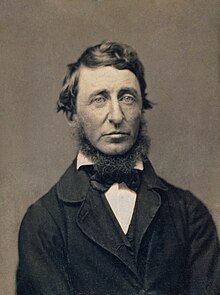
A Tribute to Henry Thoreau on his 200th Birthday

Raymond Steding
Professor Colacurcio
English 166C
June 15, 2015

Benjamin D. Maxham - Henry David Thoreau - Restored.jpgIn “The Bean Field” chapter of his memoir Walden, Henry David Thoreau describes to the reader in prose that oscillates between romanticism and realism his bean farming experiences. “The Bean-Field” does not subordinate the practicality of farming to his relationship and understanding of nature, but rather intermixes the reality of farming with his philosophical considerations of nature to arrive at a synthesis of the two. Although some may conclude that the poetic prose and lofty diction detract from the narrative, Thoreau combines images of realism and romanticism, and uses many tropes and literary devices such as personification, metaphors, mythical symbolism, and illeism to get to a level of meaning beneath the denotation of individual words, and express to the reader a sense of his spiritual affinity with nature. “The Bean-Field” seems to be written as a means for the author to understand what “Heaven knows” he was doing (107) during a time when “he was determined to know beans” (111).
Thoreau romanticizes elements of nature by personifying beans. He says that the beans “were impatient to be hoed,” and “were not easily to be put off” (107). He wonders what his beans will learn of him (107). Further, he says he was “making the yellow soil express its summer thought in bean leaves . . . making the earth say beans instead of grass” (108); They were beans cheerfully returning to their wild and primitive state that I cultivated, and my hoe played the Ranz des Vaches for them” (109). Thoreau, by way of his personification of the earth and the beans, implies that nature is as much a component of raising a bean-field as he is. Additionally he says that his “auxiliaries are the dews and rains” (107). In this way he reveals his connection to the transcendentalist philosophy that all of nature is of the individual and one mind.
The author's use of ancient cultural references is prevalent throughout “The Bean-Field,” and seems to be used by Thoreau to ascribe a sense of numinous significance to otherwise ordinary items. The author first applies such significance to beans when he says the beans “attached [him] to the earth, and so [he] got strength like Antaeus”--a Greek mythological giant that derives his strength from the earth (107). He associates the “the spotted salamander” with “a trace of Egypt and the Nile” (110). Rather than saying the beans gave him gas, the author gives his reason for not eating beans by saying that he is “by nature Pythagorean:” Pythagoras forbade his disciples from eating beans (111). The author ennobles husbandry when he says that “[a]ncient poetry and mythology suggest, at least, that husbandry was once a sacred art” (114). The paragraph in The Bean-Field in which Thoreau includes the most Roman symbolism is one in which he suggests that modern man learn the values of nature from their husbandry instead of “regarding the soil as property, or the means of acquiring property” (114). Here he uses the gods Ceres and King Saturn to imply that farmers had a special honor “they who cultivated [the earth] led a pious and useful life” (114). Thoreau says that the modern farmer “sacrifices not to Ceres [the god of corn and harvests] . . . but to the infernal Plutus [the god of riches]” (114). He speaks of weeds as Trojans and himself as Hector “that towered a whole foot above his crowding comrades--” his beans (111).
A Roman narrative technique that Thoreau employs is illeism—a way to give the text a sense of objectivity. The author does this when he switches from the first person narrator to the third person narrator as he speaks of killing weeds: “disturbing their delicate organizations so ruthlessly, and making such invidious distinctions with his hoe, levelling whole ranks of one species, and sedulously cultivating another. making such unjust distinctions . . . and sedulously cultivating another” (111). The word “his” separates the narrator from reader identification with the one carrying out the diligent but unjust decisions concerning which weeds may live, and which must die.
Thoreau uses a metaphor when he describes the Massachusetts militia practicing a mile and a half away in Concord:
It seemed by the distant hum as if somebody's bees had swarmed, and that the neighbors, according to Virgil's advice, by a faint tintinnabulum upon the most sonorous of their domestic utensils, were endeavoring to call them down into the hive again. And when the sound died quite away, and the hum had ceased, and the most favorable breezes told no tale, I knew that they had got the last drone of them all safely into the Middlesex hive, and that now their minds were bent on the honey with which it was smeared. (110)
The bees represent the militia, and the romantic elements are the tintinnabulum,—a Roman Catholic bell that is on the end of a pole—the reference to Virgil, and the honey, as a metaphor for pride and honor. Even though the metaphors detracts from the realism of his narration, he quickly corrects the imbalance in the next paragraph with the following statement: “I felt proud to know that the liberties of Massachusetts and of our fatherland were in such safe keeping; and as I turned to my hoeing again I was filled with an inexpressible confidence, and pursued my labor cheerfully with a calm trust in the future” (110). The balancing between the author's artistry at describing in poetic prose the militia and the realism of his statement of “As I turned to my hoeing again . . . [I had] . . . trust in the future” exemplifies how the author not only unifies, or synthesizes mundane and disturbing elements of realism with the mystery of nature, but also how the author's style gives him the ability to express his unity with nature to the reader (110).
In addition to the above example of realism, Thoreau includes an entire accounting of his finances, for his bean farming expenses and profits, which adds a visually realistic appearance to the “The Bean-Field:”
In all.................................. $14.72-1/2
My income was (patrem familias vendacem, non emacem esse oportet), from
Nine bushels and twelve quarts of beans sold.. $16.94
Five " large potatoes..................... 2.50
Nine " small.............................. 2.25
Grass........................................... 1.00
Stalks.......................................... 0.75
————
In all.................................... $23.44
Leaving a pecuniary profit,
as I have elsewhere said, of.............. $8.71-1/2. (112)
The author's inclusion of the phrase “patrem familias vendacem, non emacem esse oportet,” which means “A householder should be one who sells, not one who buys,” is significant (112) because a primary feature of elements of realism in literature is detail—detail helps the narrative be considered real by the reader. Here Thoreau adds directly to such detail a romantic language—a Roman phrase. On a larger scale Thoreau applies this same principle as a matter of style throughout Walden whenever he ascribes romantic qualities to his realistic detailed descriptions of nature.
In a sequence that begins with other farmers passing by his bean-field, stopping to give him advice, Thoreau begins a three paragraph long series of gradual transitions out of conversation with “hard-featured farmers” into poetic verse that culminates in an experience of joy as a sense of oneness with Nature. The sequence begins when, as narrator, Thoreau switches his point of view and refers to himself in the third person: “sometimes the man in the field heard more of travellers’ gossip and comment than was meant for his ear” (108). He objects to the hard-featured farmer’s expression of ‘“Beans so late! peas so late!”’ (108), and thinks to himself: “here were two acres and a half of furrows, and only a hoe for cart and two hands to draw it” (108). With an air of authenticity, he admits that his field was not one of the respected fields found in books on agriculture, but goes on to counter that perspective with a value judgment: “by the way, who measures the value of crop which Nature yields in the still wilder fields unimproved by man?” (109); He chooses to value his apparent layman farming methods not on its agricultural merits but with its function as a part of Nature: “[as a] connecting link between wild and cultivated fields; as some states are civilized . . . [his] field was, though not in a bad sense, a half-cultivated field” (109). He goes on to justify his reason for not using a covering of plaster or leached-ashes as pest control by telling of how a brown-thrasher bird that lands to survey his field, one that has no appetite for beans, chirps atop a tree and prevents predators from entering his bean-field: “It was a cheap source of top dressing in which I had entire faith” he says. In a tone of sincerity tempered by light-hearted rationalization, Thoreau then takes the opportunity to express a oneness with nature through transcendental imagery that begins when he disturbs the ashes of “unchronicled nations:”
When my hoe tinkled against the stones, that music echoed to the woods and the sky, and was accompanied to my labor which yielded an instant and immeasurable crop. It was no longer beans that I hoed, nor I that hoed beans”
The mundane act of hoeing his beans seems to unite him with a historic mystery of “unchronicled nations:” past and present become united with him in Nature.
In the next sentence the text establishes reader identification with the narrator’s separation from his contemporaries: “[I] remembered with as much pity as pride, if I remembered at all, my acquaintances who had gone to the city to attend the oratorios” (109). Pity and pride are two paradoxical emotions that create a psychic polarity out of which the author’s poetic prose arises to carry the reader to sense what the author experiences from bean farming. Thoreau continues to add imagery that includes a night-hawk that soars like a mote in heaven’s eye, the paradox of a torn yet seamless cope, imps of folk-lore and a hawks flight as a simile to waves of the sea. Then dreamily in a reminiscent tone he says:
Or sometimes I watched a pair of hen-hawks circling high in the sky, alternately soaring and descending, approaching, and leaving one another, as if they were the embodiment of my own thoughts. Or I was attracted by the passage of wild pigeons from this wood to that, with a slight quivering winnowing sound and carrier haste; or from under a rotten stump my hoe turned up a sluggish portentous and outlandish spotted salamander, a trace of Egypt and the Nile, yet our contemporary. When I paused to lean on my hoe, these sounds and sights I heard and saw anywhere in the row, a part of the inexhaustible entertainment which the country offers. (110)
The progression, from listening to the advice of hard-featured farmers to the use of poetic prose, filled with romantic imagery to console feelings spurred by thoughts of his “acquaintances,” synthesize through Thoreau’s diction to arrive at joy in an experience of oneness with nature. This is why Thoreau hoes his beans. And this is how Thoreau expresses the meaning through his diction to arrive at a level of understanding beneath the meaning of the words used. It is through multiple modes of expression, sincerity, reader identification, gradual progression, and the use of various tropes that combine and build off one another to form a collective sense of understanding. This is exactly what the author alludes to as being his reason for bean-farming when he says, “some must work in the fields if only for the sake of tropes and expression, to serve a parable-maker one day” (111).

Works Cited

Thoreau, Henry David. Walden, Civil Disobedience, and Other Writings, Third Edition (Norton Critical Editions). Third ed. New York: W. W. Norton, 2007. Print.

---, Walden, Oxford University Press: 1997. Print.

Saturday, June 24, 2017

Political Correctness in 1839 or How to Implicate a Whig

Raymond Steding
Professor ---
English ---
May 31, 2016
Image result for Nathanial Hawthorne
Nathaniel Hawthorne
Nathanial Hawthorne’s “Old Esther Dudley” published in “The United States Magazine and Democratic Review” (Jan. 1839) satirizes the opposition to the then ten-year-old Democratic party. The opening page of the “Review” highlights the latest New York election over the previous one by stating that “[t]he majority by which the Whigs then swept the State has been reduced between five and six thousand. The aggregate Democratic vote has been increased by upwards of forty-two thousand” (Hawthorne 3). In support of Democrats over the Whig Party, and in the style of a Hawthornian romance, “Old Esther Dudley” offers a politically didactic lesson allegorically through tone, satiric imagery, and subtle allusions to associate the Whig Party with Loyalists (Hawthorne 51). Although “Old Esther Dudley” aligns its political argument within the larger context of the “Review,” the story contains elements of a moral purpose which Hawthorne reveals eleven years later in his “Preface to The House of the Seven Gables.”  Therein, he says that “the wrong-doing of one generation lives into the successive ones . . . [and] becomes a pure and uncontrollable mischief” (Hawthorne Preface). And further, that he will be pleased to convince his reader of the folly of those that seek “ill-gotten gold, or real estate, on the heads of an unfortunate posterity” (Hawthorne Preface). Hawthorne’s moral in “Old Esther Dudley” brings about an awareness that political ideologies may change, Loyalists may metamorphosize into Whigs, but unless people stop enriching themselves at the expense of others injustice goes on much the same.
An allegory to uncontrollable mischief that attempts to transcend generations is textualized through Esther’s desire to have her memories of colonialism restored by a return of the colonies to English rule. The English Governor Sir William Howe of the Province-House describes Esther “as being so perfect a representative of the decayed past--of an age gone by, with its manners, opinions, faith and feelings, all fallen into oblivion or scorn--or what had once been a reality, but was now merely a vision of faded magnificence” (Hawthorne 54). Esther as an allegory for decayed colonial ideals represents the past: “a symbol of a departed system embodying a history in her person” (Hawthorne 55). Thus, although the system that is symbolized by Esther is separated by time, the history of it remains in the present through her. The tone of the text conjures up a kind of spooky mischief since the past should not be alive in the present. The narrator states that although her “hope ever seemed to fit around her, still it was memory in disguise” (Hawthorne 54). Esther’s hope depends on her memories of experiences within a life lived from the excesses of English colonialism. According to the political philosopher Thomas Hobbes, “if we want to point to the decay, we use “‘memory.’” Esther’s hope in the return of grand life lived under colonialism--a life of grandeur at the expense and taxation of others--brings the decaying process forward into the future. Her hope is analogous to a desire that brings with it out of the past processes of decay.
The narrator, in keeping with the theme of decaying processes entering into new forms, recites a story of old Esther’s “most frequent and favored guests . . . the children of the town” (Hawthorne 55). He states: “[b]y bribes of gingerbread of her [Esther’s] own making, stamped with a royal crown, she tempted their sunny sportiveness beneath the gloomy portal of the gloomy Province-House . . . [she would tell them] her stories of a dead world” (Hawthorne 55). The word portal means gateway or entrance, and it is a gloomy entranceway to the gloomy seat of English colonial power at the end of the revolutionary war. As a motif that appears five times within the story, the portal acts as a location where the activities that take place there symbolize the processes of the decaying past as those processes make their way into the future. It is here in the portal where Esther gives the children tasty treats while she entertains them with stories of her idealized past. Contrary to the haunting scenario of the text, Esther’s character never appears malevolent. When the child returns home, the mother says “to the little boy. ‘And did you really see [Governor Belcher] at the Province-House?’ ‘Oh yes, dear mother! Yes!’ the half dreaming child would answer” (Hawthorne 56). The text continues: innocently enough, “without affrighting her little guests, she [Esther] led them by the hand into the chambers of her own desolate heart, and made childhood’s fancy discern the ghost that haunted there” (Hawthorne 56). The child-like tone of the text contrasts with the narrator’s stark conclusions to imply that agents (such as Esther) of the transference of idolization of wealth that pass from one generation to the next are unconscious and therefore innocent of the associated human costs.
The difficulty of writing a story that attempts to persuade a reader of a moral purpose is that it must confront the dark side of the reader’s personality enough for them to see right from wrong without offending them. Since morality can only exist within the individual constituents of a political party, if the text is to make a moral argument against the desire for excessive wealth, then it must confront the selfish desire for wealth which nearly every reader has. The narrator states that “[i]t took no small nerve [on the part of the new authorities] to look her [Esther] in the face” (Hawthorne 54). The implication of the text is that in making a political argument to its readers, the “new authorities” equate with the Republican-Democrats of 1776 but at the same time less directly to its readers. It will take no small nerve on their parts to look at the bloody greed behind the excesses of colonialism that Esther innocently idealizes, as being alive and well in themselves, and it will take no small nerve to see that projecting an excessive desire for wealth on to political opponents does anything more than make one self-righteous. Appropriately enough, a mirror, a device used to look at oneself, allows colonialists to appear in “the inner world of the mirror with shadows of old life” (Hawthorne 54). The mirror brings these old attitudes held by the colonialists into the Province House, which is now under the rule of new authorities. Presumably the shadows of old life will not assault the reader like the shadow of the Province-House that “flings its shadow on the loiterer in its courtyard” (Hawthorne 51), but instead allow the reader to comfortably project their greediness onto their political opponents and yet cause them enough awareness to question whether or not their political choices are being driven by desires for excess wealth.
Although Hawthorne provides a moral, he does not want “to impale the story (House of the Seven Gables) with its moral, as with an iron rod” (Hawthorne Preface). And, within “Old Esther Dudley” he employs various techniques within in his style of romance to teach a subtle moral lesson to his reader. The way that the romance novel comes under the romantic definition according to the author “lies in the attempt to connect a by-gone time with the very present that is flitting away from us. It is a legend, prolonging itself, from an epoch now gray in the distance, down into our own broad day-light.” He goes on to say that “the reader, according to his pleasure, may either disregard, or allow it [the stories legendary mist] to float almost imperceptibly about the characters and events for the sake of a picturesque effect” (Hawthorne Preface). One such example of the author’s romantic style follows:
And, punctually as the clock of the Old South told twelve, came the shadows of . . . all the grandees of a bygone generation, gliding beneath the portal into the well-known mansion, where Esther mingled with them as if she likewise were a shade. Without vouching for the truth of such traditions, it is certain that Mistress Dudley sometimes assembled a few of the staunch, though crest-fallen old tories, who had lingered in the rebel town during those days of wrath and tribulation. (101)
The above passage indicates a time of communion between a ghostly bygone generation, or between crest-fallen old tories that are real. The truth of the matter is not as important to the text as is the effect of the picturesque upon the reader’s perception of what happens to those that believe in a doomed political system.
Hawthorne’s narrator continues to describe a scene in the author’s style of romance writing that parallels a strikingly similar historical scene in 1766 that the biographer Harlow Unger explains. A comparison between Unger’s and Hawthorne’s depiction highlights the way the author’s style helps him reveal his lesson to his reader despite what others may consider historical fact. The historical record from “those days of wrath and tribulation” by Unger documents a time when John Hancock wins the repeal of the Stamp Act, and Royal Governor Bernard celebrates, believing that the repeal signified peace between England and the colonies: “At Province House, the governor’s mansion on Marlborough Street, Governor Benard celebrated Repeal Day with his Council by drinking His Majesty’s health, before stepping out courageously to mingle with the rest of Boston” (Unger 107-8). In contrast to such an honorable event, the romance style of Hawthorne’s narrator paints the Loyalist’s gathering in “Old Esther Dudley” as activities of treasonous has-beens:
Out of a cobwebbed bottle, containing liquor that a Royal Governor might have smacked his lips over, they quaffed healths to the King, and babbled treason to the Republic, feeling as if the protecting shadow of the throne were still flung  around them. But, draining the last drops of their liquor, they stole timorously homeward, and answered not again, if the rude mob reviled them in the street. (Hawthorne 55)
Whether or not Hawthorne relied on the same source material as Unger, the differences in the two passages exemplify the extent to which Hawthorne’s style allowed his story to emphasize the temporality and impotence of those who idealize systems of governance.
Other formal elements of Hawthorne’s style such as the use of overstatement suggests absolute certainty to such a degree that it makes the pronouncements within the text imply their opposite. When Esther routinely watches out with hopes of seeing the return of a British ship, “the passengers in the street” would yell out to her, “‘When the golden Indian on the Province-House shall shoot his arrow, and when the cock on the Old South spire shall crow, then look for a Royal Governor again!’” (Hawthorne 57). The absurdity of an image such as a golden Indian or a metal rooster coming to life stands humorously juxtaposed to Esther’s undying faith. The irony of the statement is that the text suggests that an equivalent to a Royal Governor returns. When the narrator says that John Hancock, a New England merchant, trod [his foot] upon humbled royalty, as he ascended the steps of the Province-House, the people’s chosen Governor of Massachusetts,” a continuity in the sense of wealth inherited from the word “merchant” combines with a sense of power from the phrase “trod upon humbled royalty.” Thus, the text gives the impression that both wealth and power ascend under the rule of Hancock. The image stands in contrast with the subtlety of the last phrase “the people’s chosen Governor of Massachusetts” (Hawthorne 57). So it is with a touch of sarcasm, the text implies that both wealth and power begins to rule again.
The text makes other parallels between Hancock and Royalty. When Esther collapses upon the realization that Hancock is a traitor to the King, Hancock says to her, “Your life has been prolonged until the world has changed around you” (Hawthorne 58). Since Esther “is “a symbol of a departed system embodying a history in her person” (Hawthorne 55), and her “life has been prolonged until the world has changed around [her],” is it not possible that John Hancock will replace King George’s rule and continue similar practices under a new political system? The text makes the allusion that Hancock may become a king when the narration by General Howe says, “King George’s head on these golden guineas is sterling yet, and will continue so, I warrant you, even should the rebels crown John Hancock their king” (Hawthorne 53). The narrator’s statement of Howe suggests two meanings: an actual meaning that the guineas will retain their intrinsic value as gold despite a change in political systems, and an alluded to meaning that John Hancock as Governor will honor money like King George. A detailed description of what the historical John Hancock idealized comes from the opening pages of John Hancock: Merchant King and American Patriot by Harlow Giles Unger: “Hancock loved wealth. He reveled in it. He adorned all the foppish trappings it could buy: the fashionable wigs, frilled shirts, silk and velvet jackets and breeches” (Unger 1). The depiction of Hancock by Unger reveals that he idealized the parts of the English culture as much as any Loyalist.
The text further implicates Hancock as a Loyalist sympathizer when he stands in the portal of the Province-House with Esther, just before she collapses in death, and says to his entourage “let us reverence, for the last time, the stately and gorgeous prejudices of the tottering past!” The words, reverence, stately and gorgeous, have a tone of honorable admiration for what Hancock describes as prejudices --harmful actions--of a tottering past--a political system in decline. Hancock’s words to his men imply that the “stern republicans” honored the excesses of wealth as much as the Loyalists and the problem is not the desire for wealth but the decline of their system. The text's ironic portrayal of Hancock implies the authors moral. The imagery when Esther collapses between the pillars of the Province House portal and the key to falls from her hands suggests that Hancock replaces her function. They stand in the gloomy portal where decaying processes pass from one generation to the next, and it is there that Esther cries out her final plea “God save the King!” It is not difficult to imagine that readers would make the connection between King George and the Merchant King, John Hancock.  Further, despite Hancock’s proclamation of “‘We are no longer children of the past!,’” he precedes his statement with “‘We will follow her [Esther] reverently to the tomb of her ancestors; and then, my fellow-citizens, onward--onward!’” (Hawthorne 59). Reverence for Esther implies reverence for the attitudes that she held for the English colonialists. The Hawthornian humor in Hancock’s statement “We are no longer children of the past” is that it is an ironic statement. The new rulers of America shall continue blind to their self-serving attitudes in the same historical way as the colonialists unless they become conscious of the greed that drives them onward.
A satire of the “stern republicans” (Hawthorne 55) who unknowingly carry forward under a new guise the same idealization of wealth as the English colonialists presents the readers of the US Magazine and Democratic Review with a humorous depiction of the founders of “America’s first political party, the Whigs” (Unger 87). The Whigs of 1768 became Republican-Democrats after the revolutionary war. The text connects Hancock to “stern republicans” through an unsaid but well-known fact that Hancock was a Whig. Thus, the text implies through understatement that the opponents of the Democratic Party of 1839 have the same drive for excessive wealth as the American Whigs of the 1760s had. The text suggests that the decaying processes brought forward through old Esther have continued through John Hancock into the-the United States political system and continue to exist within the aspirations of the Whig party of 1839.
Old Esther Dudley” satirizes the Whig party of 1839 through Hawthorne’s form of romance story-telling which pulls the reader into political dialogue with the text.  By taking the liberty of naming John Hancock as a republican rather than as an American Whig the narration allows the reader to associate Hancock to the Democratic Party’s opposition. Through the subtlety of the author’s romance, and through literary features such irony, tone, overstatement and understatement, the text gently confronts the desire for wealth within individuals to help them question whether or not their political party of choice will bring the change they desire. “Old Esther Dudley” is not simply a political satire but a lesson for all that support political parties to look into a mirror to see if their hope resides in the idealization of excess rather than in a political system.


Works Cited


Hawthorne, Nathaniel. "Old Esther Dudley." Making of America: The United States
Magazine and Democratic Review: 1839 (Vol. 5-6). ebooks.library.cornell.edu. Web. 29 May 2016.
--.”Preface to The House of the Seven Gables.” etc.usf.edu. University of Southern Florida. Web. 29 May 2016.
Unger, Harlow Giles. John Hancock: Merchant King and American Patriot. New York:
John Wiley & Sons, 2000. Print


A Digital Humanities Study of Reddit Student Discourse about the Humanities

A Digital Humanities Study of Reddit Student Discourse about the Humanities by Raymond Steding Published August 1, 2019 POSTED ...